43 chemical and physical change lab
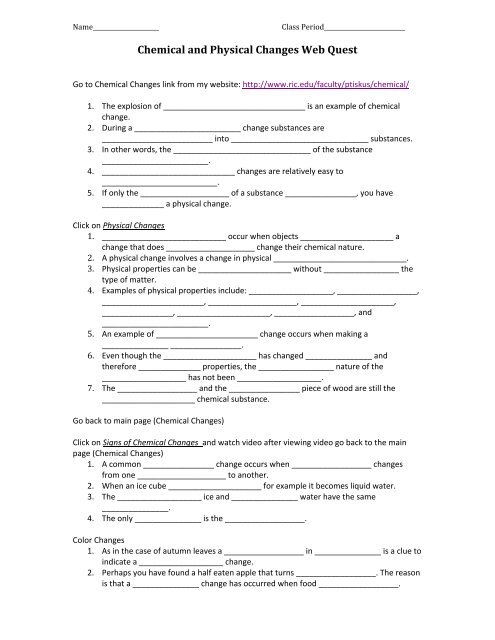
DOC Physical and Chemical Change Experiments A physical change involves a change in physical properties. Physical properties can be observed without changing the type of matter. Examples of physical properties include: texture, shape, size, color, odor, volume, mass, weight, pH and density. Chemical changes are changes substances undergo when they become new or different substances. Lab Report_ Physical and Chemical Changes.pdf - Lab Report ... Lab Report: Physical and Chemical Changes The purpose of this lab is to invest time into understanding the difference between a chemical and physical change by performing an experiment. In this lab, examples such as calcium carbonate, water, iron filings and sulfur, etc. were showcased to investigate a type of change and the reasoning for the change.
DOC Lab Activity: Physical and Chemical Change Aluminum ball Physical and Chemical Change Lab Activities OBSERVE and DESCRIBE all reactants first (3 properties for each reactant). Follow the instructions at each station carefully. CLEAN UP EVERYTHING when you are done. Dispose of all chemicals as instructed (some go down the drain, and some are emptied into a waste beaker).

Chemical and physical change lab
Physical and Chemical Properties and Changes Lab Physical and Chemical Properties and Changes Lab Station 1 Color Station Instruction: Describe the color of the following substances. Substance Color 1. Sulfur _____ ... Based on your observation, is the FLAMMABILITY OF PAPER/ALUMINUM a: physical change or chemical change (Circle one) ... Lab Physical And Chemical Changes Student Guide - Pic ... Physical and chemical changes the purpose of this lab is to take time to understand the difference between a chemical and physical change by performing an experiment. Zinc with dilute sulphuric acid. For Example, If Wood Were Burned, The Cellulose In The Wood Would Be Converted To Carbon Dioxide And Water. PDF Lab Handout Lab 2. Chemical and Physical Changes - NSTA melts (see Figure L2.1). Scientists classify changes in matter as either a chemical change or a physical change. A chemical change is defined as a change in the composition and properties of a substance. Chemical changes involve the rearrangement of molecules or atoms and result in the pro-duction of one or more new substances. A physical change
Chemical and physical change lab. conclusion for phyical and chemical changes lab In "Physical and Chemical Changes" lab, how can you justify melting of FeCl3 is a physical change. Support your answer from the test results you obtained in the lab. Posted 8 days ago. Q: Exploring Energy Changes - Page 6 Post-Lab Questions Attach The Printout Of The Data Table And Graph For Part B To Your Lab Report. ... PDF Physical and Chemical Changes Packet Physical Change Chemical Change Explanation 1. ice melting This is a physical change because H 2 O is changing from a solid state to a liquid state. The H 2 O molecule remains the same, just in a di erent state of matter. 2. cutting a pineapple into pieces This is a physical change. The molecules that make up the pineapple are not being Physical and Chemical Change Activities for Middle School ... The Physical and Chemical Changes Inquiry Lab is a hands-on activity that is differentiated for advanced, on-level, and modified middle school students. Students will distinguish between physical change and chemical change by completing the process of saponification (making soap). Additionally, students will observe an exothermic reaction. PDF General Chemistry I (FC, 09 - 10) Lab # 6: Physical and ... Lab # 6: Physical and Chemical Changes 1 One of the basic areas of interest for chemists is the study of the regrouping of atoms to form new substances. In order to determine if such a chemical change has occurred, there should be a change in the properties of the reactants that can be observed. The reaction, for example, of
PDF Name: Date: Investigation #1: Physical or Chemical Change? In the simplest sense, a physical change is a change in the form of the original substance. A chemical change is a change in the composition of the original substance. A chemical change is also called a chemical reaction. Chemists have developed a list of common signs that may indicate the occurrence of a chemical change. These include: 1. DOC PHYSICAL AND CHEMICAL CHANGES LAB - Livingston Public Schools Grinding, melting, dissolving, and evaporating are all physical changes. No new substance or substances are formed as a result of a physical change. A chemical change results in the formation of one or more "new" substances. These new substances differ in chemical properties and composition from the original substance. PDF Physical and Chemical Changes - Science4Inquiry G. Kitts, A. Cuellar, M. Aquino Printed on 1/25/17 Physical and Chemical Changes page 5 NOTE: This demonstration should be conducted by the teacher due to the concentration of the hydrogen peroxide. Wear rubber gloves to protect against burns caused by concentrated hydrogen peroxide. Chemical and Physical Changes Lab - SHiPS Education Chemical and Physical Changes Lab In this activity (third in a series), students develop observation- and peer argumentation skills.They mix chemicals without any preconceptions of what may occur. This approximates the discovery process that Mendeleev and his precursors experienced discovering properties of the sixty-some elements that provided enough data from which to generalize a periodic law.
DOC Physical and Chemical Changes Lab Grinding, melting, dissolving, and evaporating are all physical changes. No new substance or substances are formed as a result of a physical change. A chemical change results in the formation of one or more "new" substances. These new substances differ in chemical properties and composition from the original substance. Physical and Chemical Changes Lab.doc - Physical and ... Physical and Chemical Changes Lab The purpose of this lab is to distinguish between physical and chemical changes. Below are various procedures that you can do to demonstrate that you know the difference between a physical change and a chemical change. You will need to answer the associated analysis questions for each procedure performed. In addition to carrying out the procedures, you need to ... Chemical and Physical Change Lab Activity Lab Activity ⋆ ... Before you begin your Chemical and Physical Change Lab make sure your students understand the following. Physical changes usually involve a change to a substances state of matter where heat energy is added or removed. The molecular structure of the substance remains the same. For this reason, physical changes can be reversed. Physical And Chemical Change Lab Report - 1887 Words ... A physical change includes a change in the material without affecting its composition, such as the physical state change. However, a chemical change includes the change in the composition of the substance.
amritalab - Twitter Search / Twitter
5 Experiments of Physical and Chemical Changes Matter is composed of atoms and molecules and is always changing its form by either physical or chemical changes. The Law of Conservation of Mass states that mass is neither created nor destroyed during any physical or chemical changes. A physical change occurs when the appearance of a substance changes but its chemistry remains the same.

Physical Chemical Change Lab
Chemical And Physical Change Lab Worksheets & Teaching ... The Physical and Chemical Changes Station Lab takes students through eight student-led science stations, each with a different learning style. Students begin with four input activities where they read articles, explore hands-on demos, research online, and watch videos all about physical and chemical Subjects: Science, Chemistry, General Science

Chemical and Physical Change Lab Activity Lab Activity ...
PDF Lab-Physical and Chemical Changes OR: If a substance undergoes a chemical change, then it will not retain its original properties because a new substance is formed You WII conduct 8 experiments and determine whether you observed a physical or chemical change. Behavior in the lab must be purposeful. Be sure to do the following: Keep work area clear and uncluttered.

LAB: Physical or Chemical Change
PDF Physical and Chemical Changes - Mr. Powell Science Objective 2: Observe and evaluate evidence of chemical and physical change. a. Identify observable evidence of a physical change (e.g., change in shape, size, phase). b. Identify observable evidence of a chemical change (e.g., color change, heat or light given off, change in odor, gas given off). Intended Learning Outcomes (ILOs) 1.

Chemical and Physical Changes Lab ⋆ iTeachly.com
Physical and Chemical Changes Lab Report (Patricio Garcia ... Physical and Chemical Changes Lab Report. Question: How can you distinguish a physical change from a chemical change? Purpose: To be able to distinguish whether an item has undergone physical or chemical change. Hypothesis: If a material undergoes a chemical change, then it will not retain its original properties because a new substance is formed.

DOC) CHEMICAL & PHYSICAL CHANGES LAB | Troll Master ...
Physical And Chemical Changes Lab Teaching Resources | TpT The Physical and Chemical Changes Station Lab takes students through eight student-led science stations, each with a different learning style. Students begin with four input activities where they read articles, explore hands-on demos, research online, and watch videos all about physical and chemical changes.

Physical and Chemical Test Tube Stations Answer Key
Chemical and Physical Changes Lab ⋆ iTeachly.com 3-1 Chemical and Physical Change - Lab Answers(Doc) Background Theory: Physical changes usually involve a compounds state of matter where heat energy is added or removed. For this reason, physical changes can be reversed. By contrast, chemical changes occur at the molecularlevel when two or more molecules are interacting.

Physical and Chemical Change — The Wonder of Science
PDF PHYSICAL AND CHEMICAL PROPERTIES LAB - Weebly Physical change Change in the form or state of a substance, for instance, from solid to liquid or liquid to gas or solid to gas, without changing the chemical composition of the substance.. As we will see later, chemical bonds are not broken in a physical change. Examples: Boiling of water and the melting of ice. Chemical change Chemical Change ...
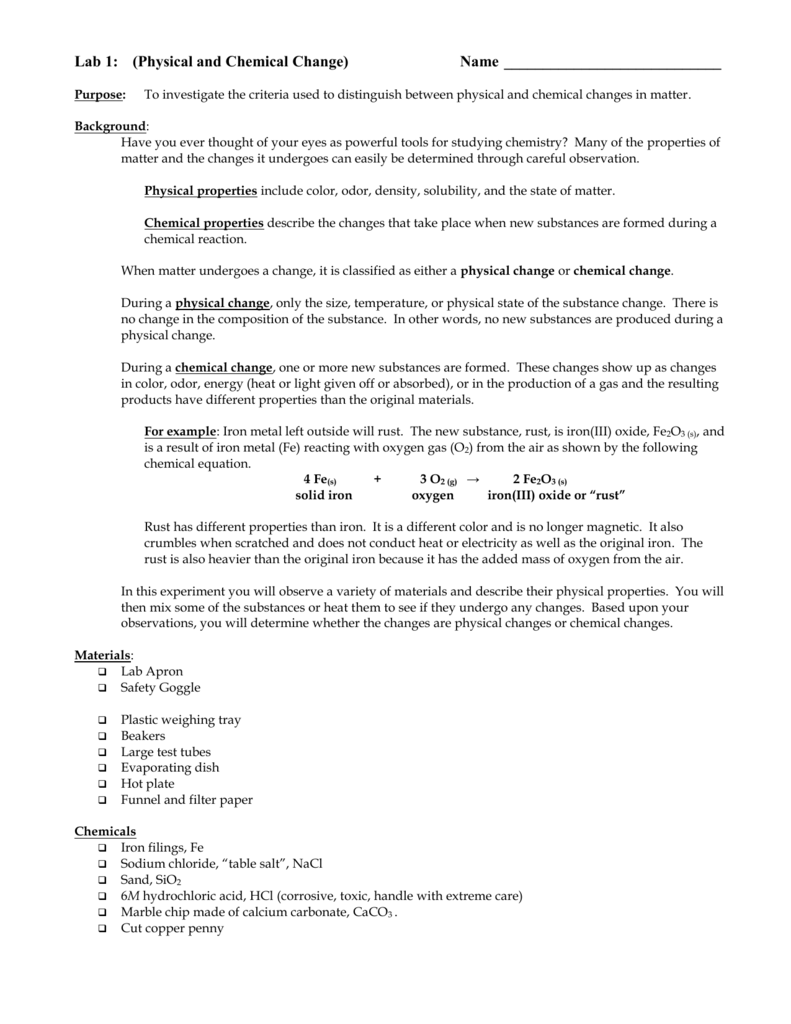
Physical and Chemical Change
Physical and Chemical Change.pdf - Lab 6 Examination of ... Learning Objectives • Understand the difference between a physical and chemical change, and physical and chemical properties • Examine the density of household solutions • Determine the identity of an unknown substance based upon its physical and chemical properties LAB 6 Examination of Physical and Chemical Properties INTRODUCTION Matter is all around us.
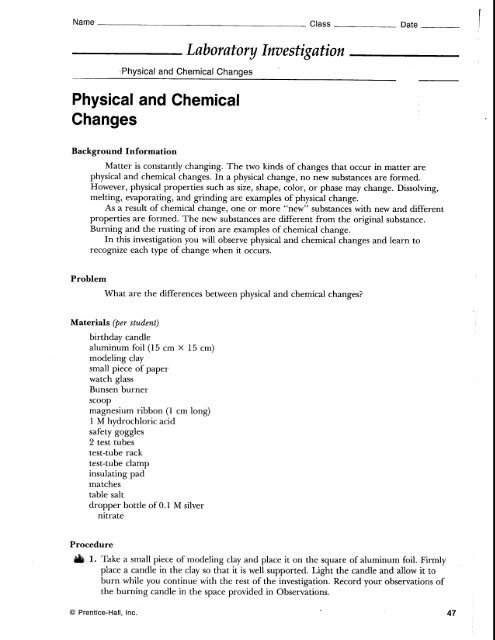
Lab Investigation - Physical and Chemical Changes
PDF Lab: Chemical and Physical Changes in Matter - LCPS Lab: Chemical and Physical Changes in Matter Introduction Matter can be classified in different ways using physical and chemical properties. These properties must not be confused with physical and chemical changes. A physical change refers to a transformation of a substance in which the physical properties change, and the chemical composition of

Chemistry Lab #1 .pdf - Title: Physical and Chemical Changes ...
DOC Physical & Chemical Change Lab - The Science Queen Some general signs of a chemical change include a change of color or odor, the formation of a precipitate (solid), the formation of a gas, and a change in heat or light. In this lab, you will perform different activities and, based on your observations, determine whether a chemical or physical change has taken place.

Lab4Data-Flegel Kayla - Exploring Physical and Chemical ...
PDF Lab Handout Lab 2. Chemical and Physical Changes - NSTA melts (see Figure L2.1). Scientists classify changes in matter as either a chemical change or a physical change. A chemical change is defined as a change in the composition and properties of a substance. Chemical changes involve the rearrangement of molecules or atoms and result in the pro-duction of one or more new substances. A physical change
Teacher Resources Physical or Chemical Change?
Lab Physical And Chemical Changes Student Guide - Pic ... Physical and chemical changes the purpose of this lab is to take time to understand the difference between a chemical and physical change by performing an experiment. Zinc with dilute sulphuric acid. For Example, If Wood Were Burned, The Cellulose In The Wood Would Be Converted To Carbon Dioxide And Water.

Physical and Chemical Change Virtual Lab
Physical and Chemical Properties and Changes Lab Physical and Chemical Properties and Changes Lab Station 1 Color Station Instruction: Describe the color of the following substances. Substance Color 1. Sulfur _____ ... Based on your observation, is the FLAMMABILITY OF PAPER/ALUMINUM a: physical change or chemical change (Circle one) ...
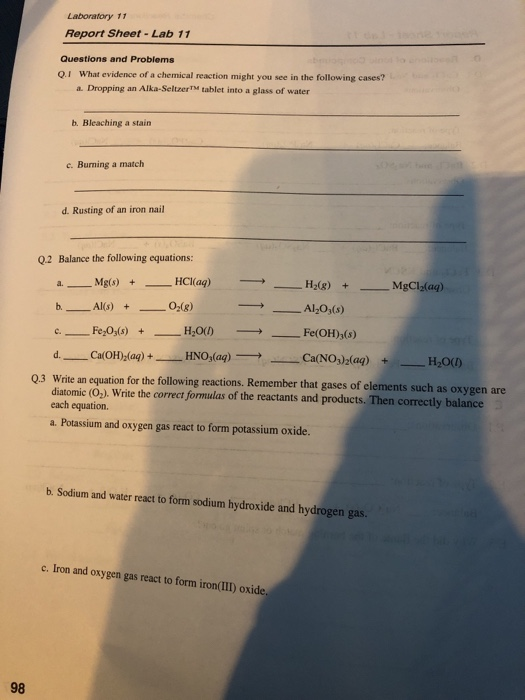
Physical And Chemical Change Lab Report | kcpc.org

Exploring Physical and Chemical Changes Lab
Polyurethane Foam: Physical and Chemical Changes—ChemTopic ...
Experiment 3 – Chemical and Physical Properties of Materials

Chemical and Physical Changes Station Lab - Specialized ...
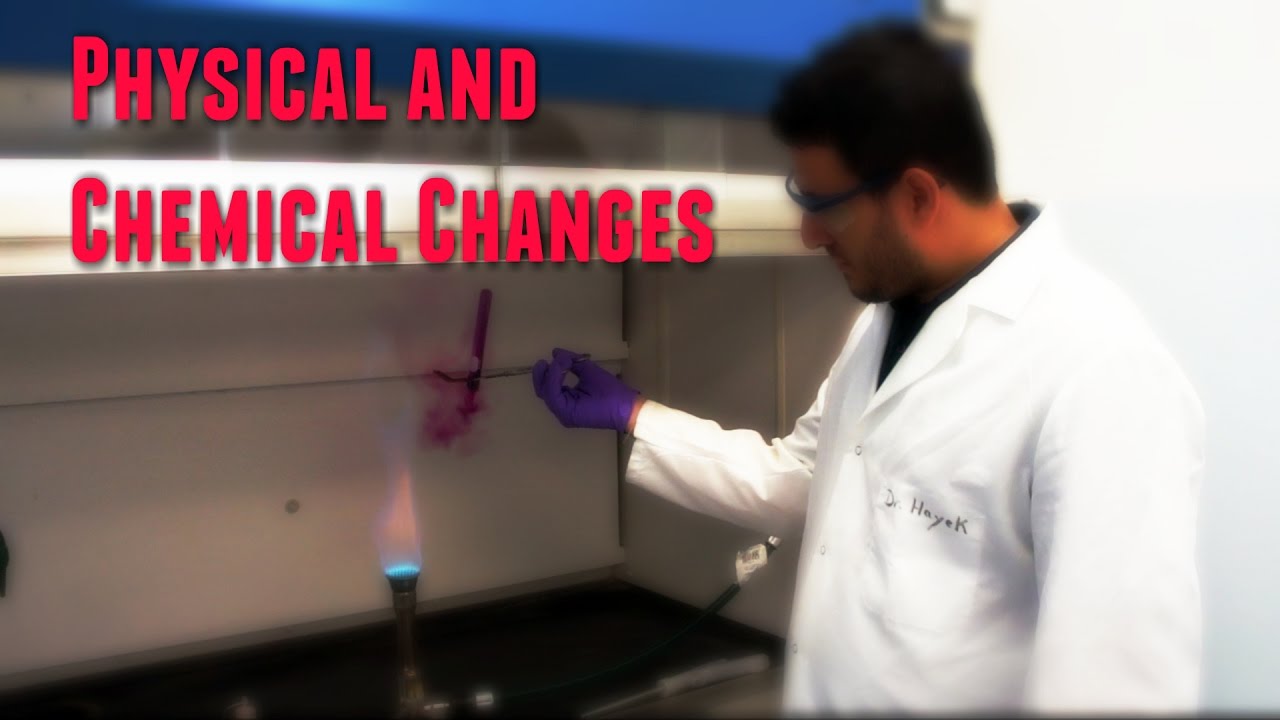
Lab Experiment #2: Physical & Chemical Changes.
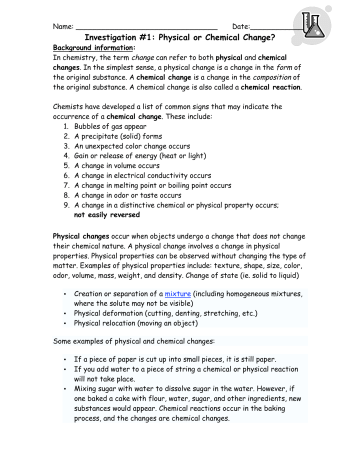
Lab - Physical or Chemical Change | Manualzz

Chemical/Physical Change Lab

Chemical vs Physical Change Lab Questions - Mrs. Ellingson's ...

Physical vs. Chemical Change Lab
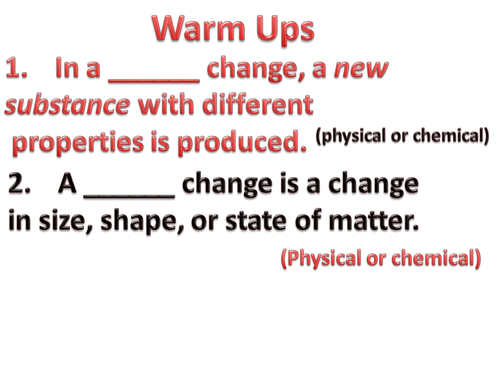
Lab on Physical vs. Chemical Properties | Teaching Resources

Physical & Chemical Changes Lab | Chemical changes, Chemical ...

Chemical and Physical Changes Station Lab Hands-on Activity ...
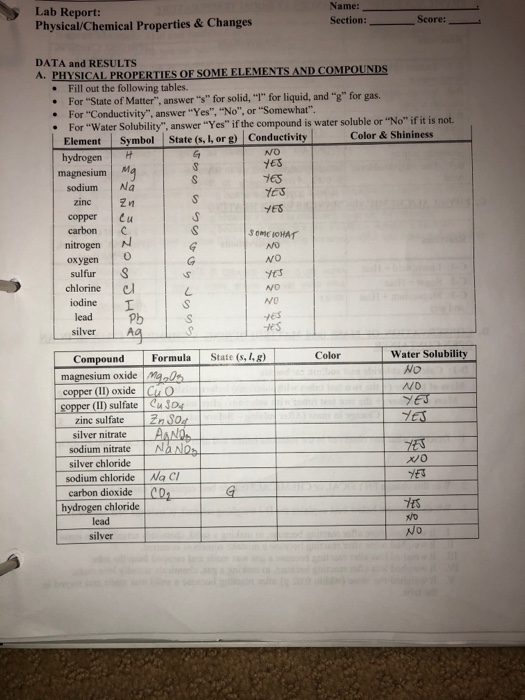
Solved Lab Report: Physical/Chemical Properties & Changes ...
Untitled

Virtual Lab Chemical And Physical Changes - Fill Online ...
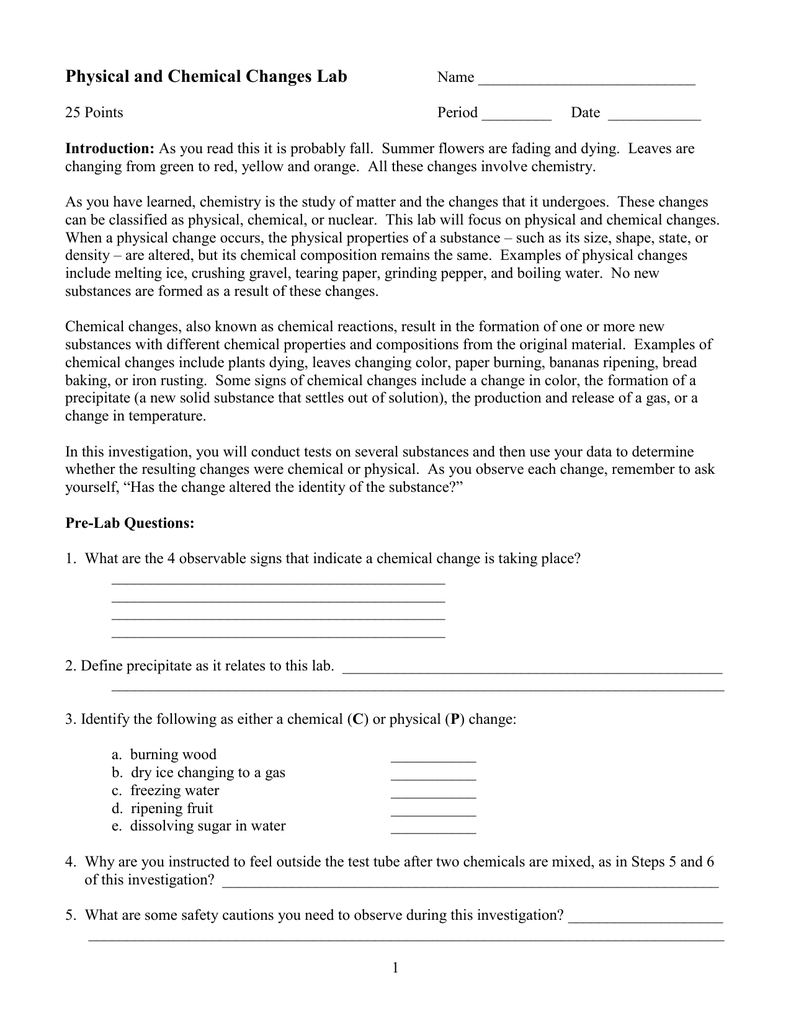
Physical and Chemical Changes Lab
Chemical and Physical Change Lab
vii - CHEMICAL PROPERTIES - MR. SARBACKER
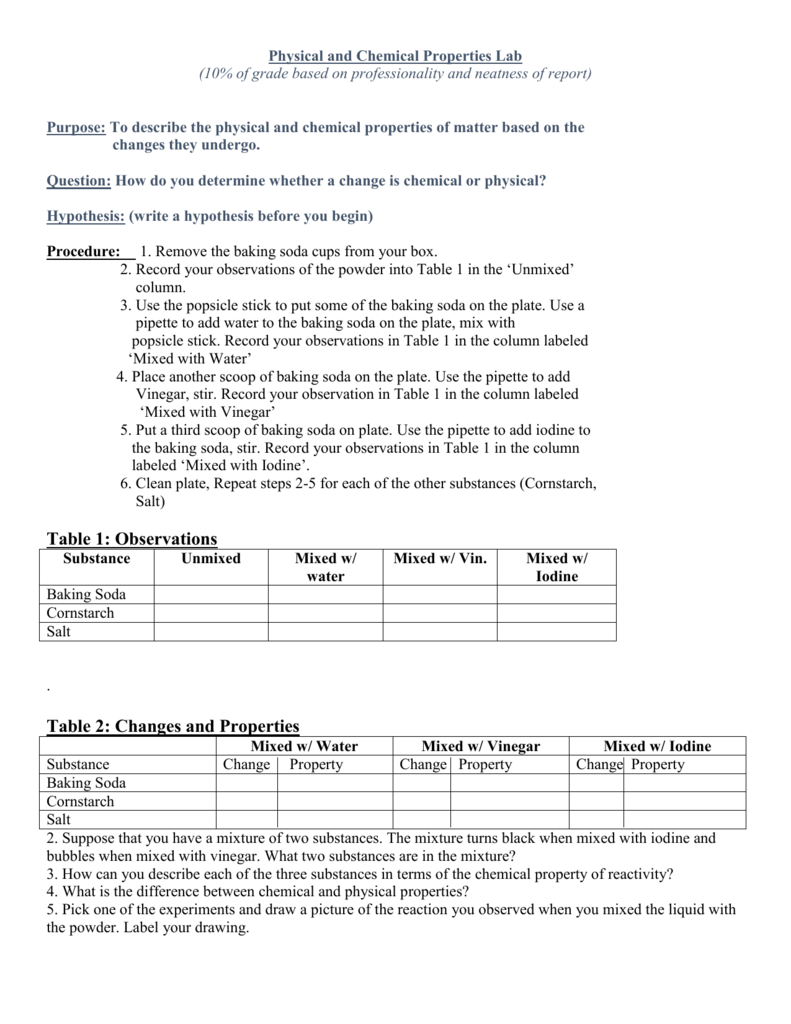
Physical and Chemical Properties Lab

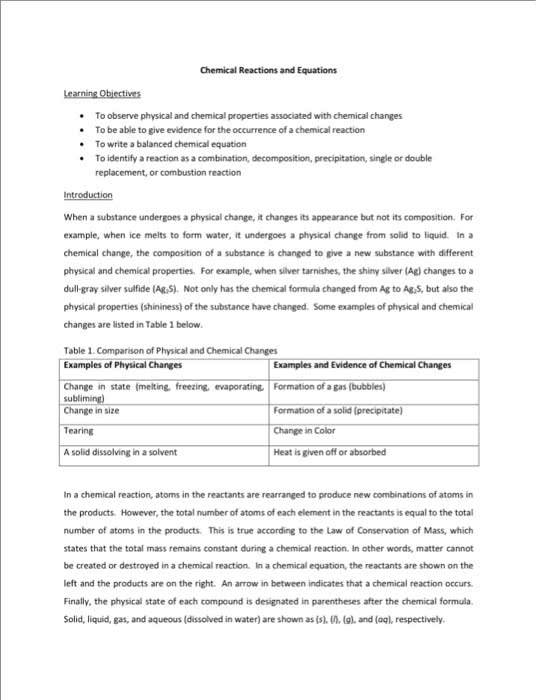
Physical Changes and Chemical Reactions - PDF Free Download
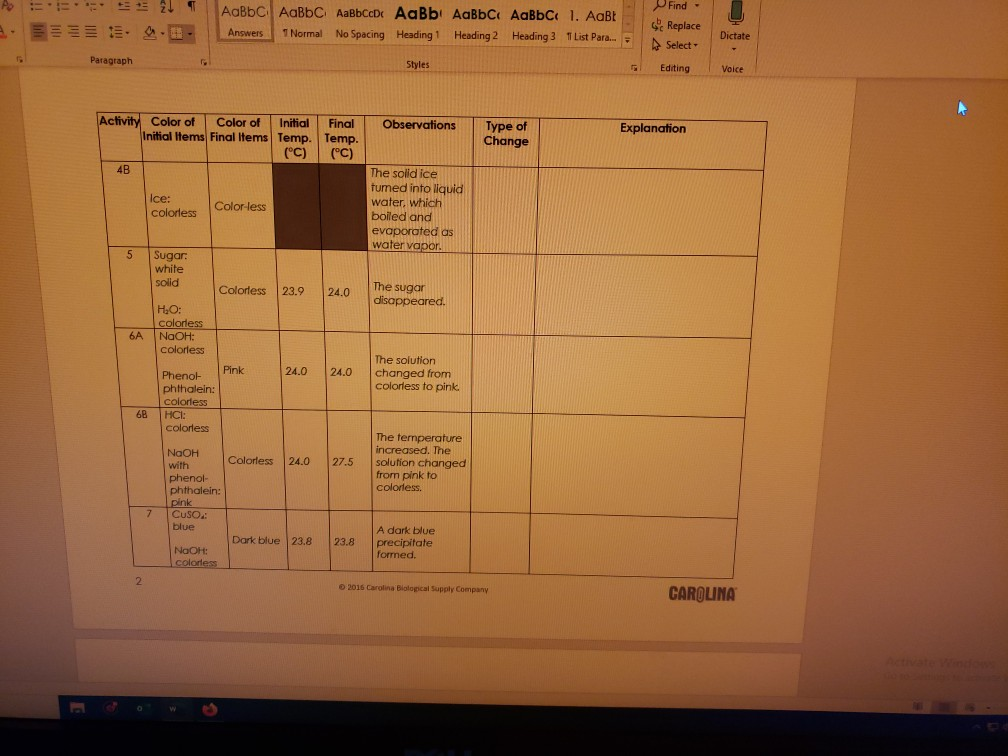
Solved state whether chemical or physical change and why ...

Think-About-It-Thursday: Physical Properties and Physical ...
Physical Change vs Chemical Change Lab
OneClass: I need help doing my lab homework, I missed lab ...
Chemical & Physical Changes Virtual Lab activity
Physical and chemical changes lab sheet - Warren County Schools

Lab 4: Chemical and Physical Changes

Lesson Chemical and Physical Changes Lab Stations | BetterLesson
0 Response to "43 chemical and physical change lab"
Post a Comment